

Cultural Viscera
An independent research and digital product exploring the inner layers of messaging, culture, and communication.
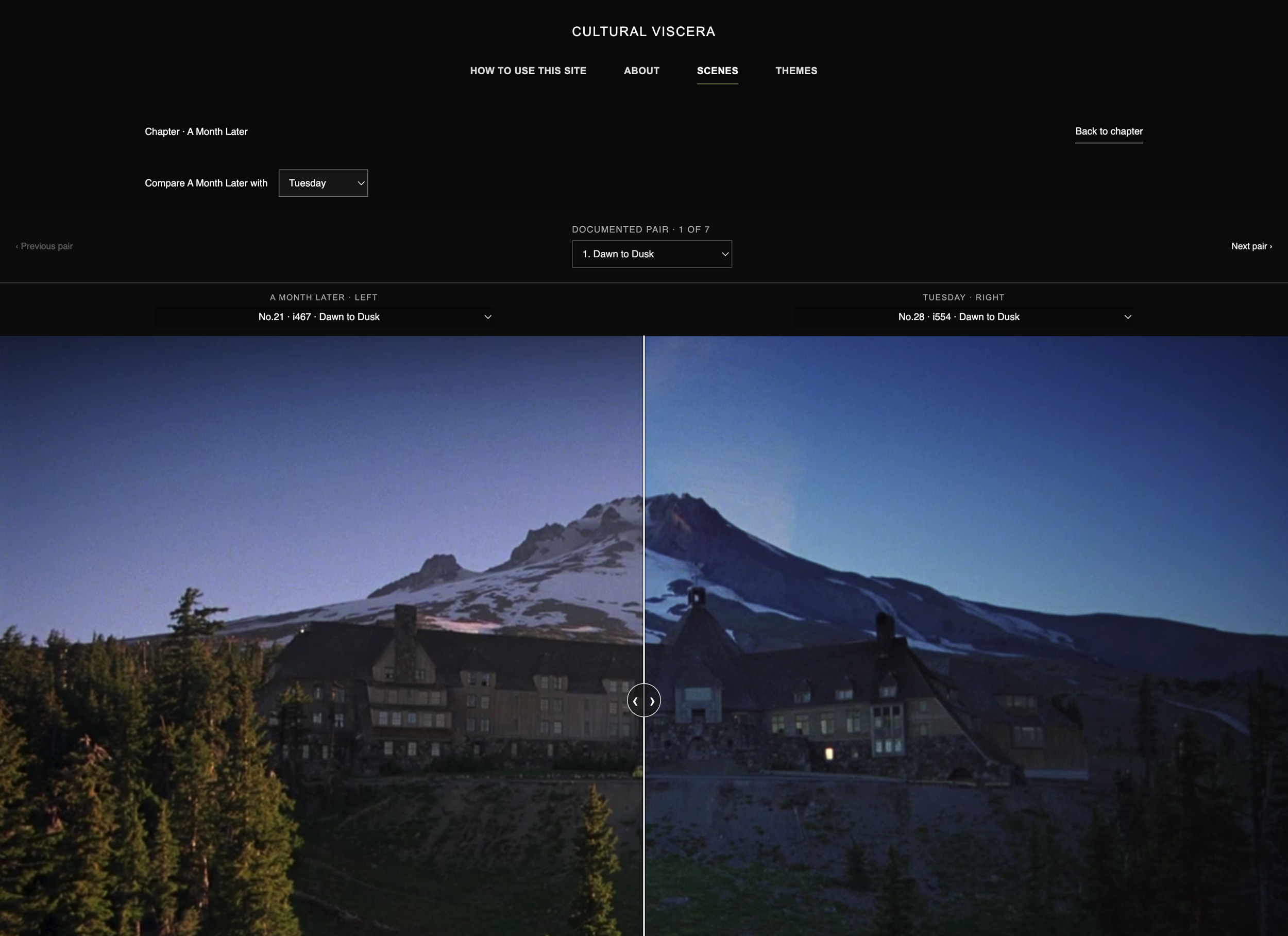
The finished platform brings cultural research, editorial thinking, and interactive software into a single exploratory experience. The Shining is its first substantial subject: a way to investigate visual, sonic, narrative, and historical relationships without being given a prescribed interpretation.
The visual language has always been restrained and dark, conceived as a contemporary microfiche experience. The goal is to draw people into dense and abstract information through curiosity and play, rather than making them feel lectured.
Explore the live product, then follow the process behind it.
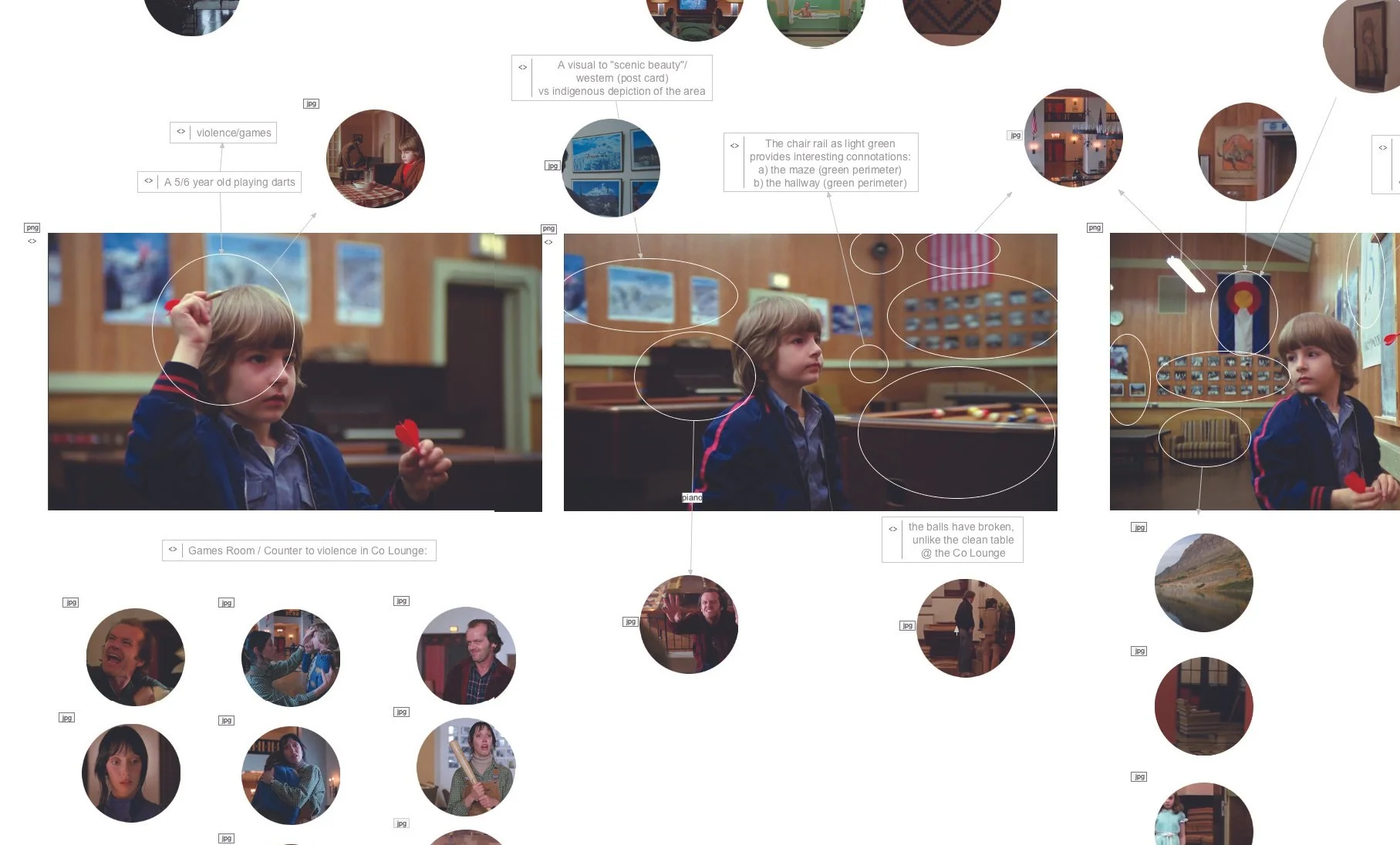
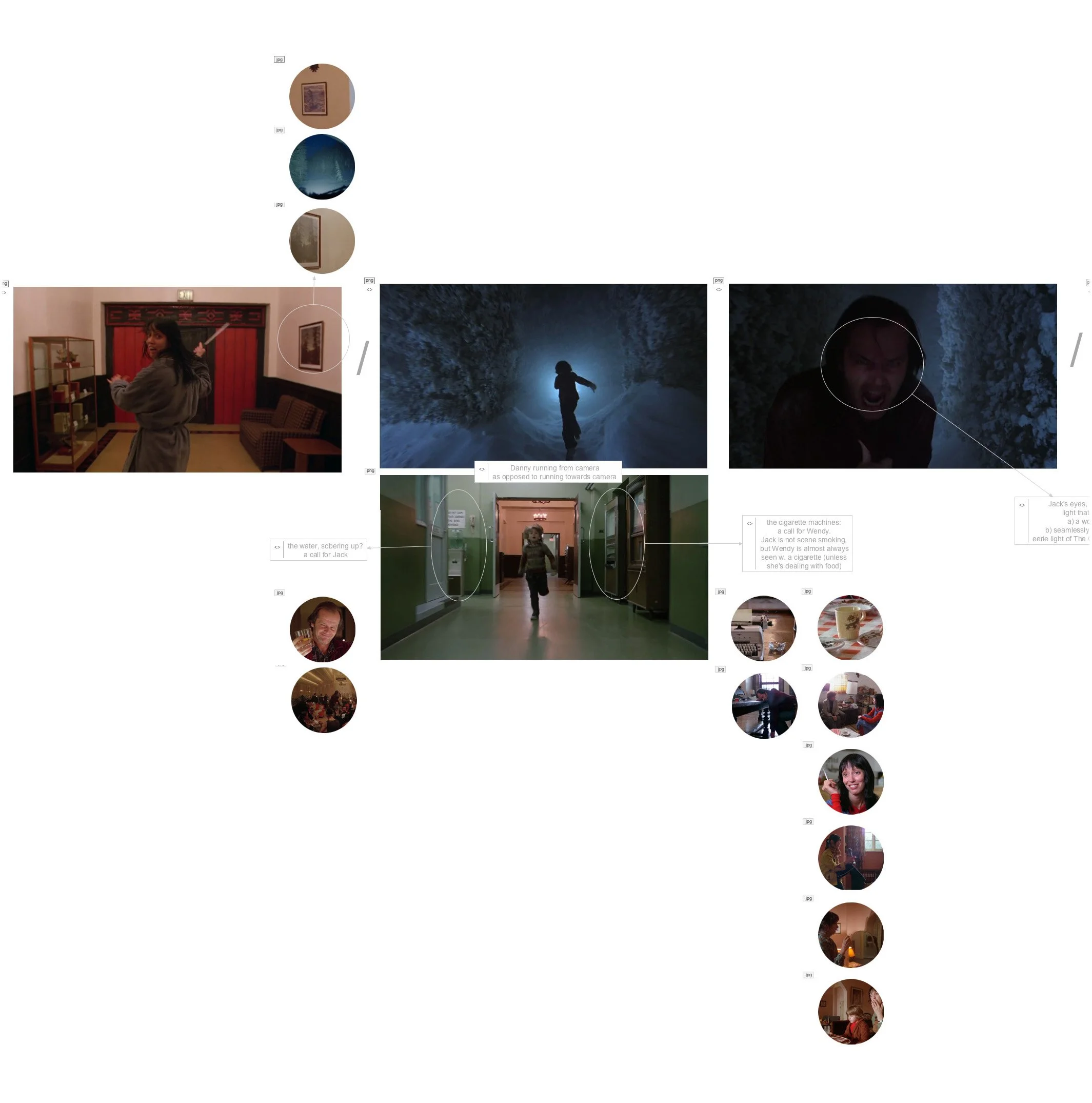
The research began as a detailed visual investigation of The Shining, documenting recurring imagery, compositions, sounds, devices, and relationships across the film.
These charts are artifacts of the analytical work: not simply illustrations of conclusions, but ways of recording observations, testing connections, and seeing larger patterns emerge. The research charting developed over several years.
Early interface experiments made one problem clear: the research had to be mapped more thoroughly before it could be presented as a useful interactive experience.
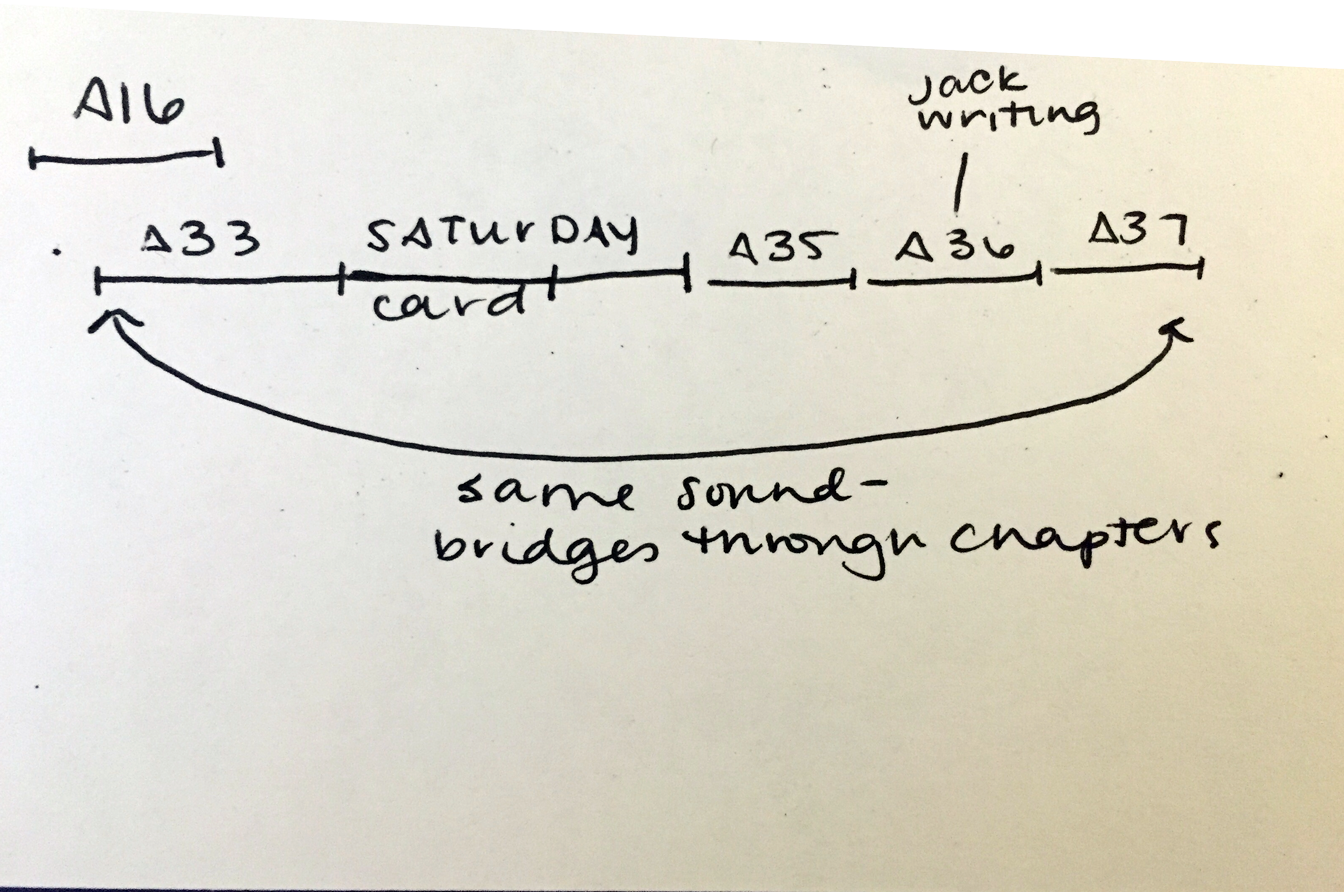
I stepped away from interface design and began writing detailed scene worksheets, thematic indexes, and cross-references. A theme could lead to many scenes; a single scene could lead to many themes, sounds, compositions, and other observations.
The handwritten notes show those relationships being worked out. The typed documentation establishes a more systematic means of recording and retrieving them.
The product was part of the original vision in 2010. The first design proposed a scene-based digital experience, with numbered navigation, filmstrip imagery, and a dark archival viewing environment.
Subsequent interface directions explored how to layer interpretation, scenes, and navigation. One direction made the underlying challenge impossible to ignore: a better interface alone could not compensate for information that still needed more rigorous mapping.
That decision led back to the research documentation. The current Cultural Viscera platform carries forward the original exploratory ambition with a far more developed informational foundation.

Theme Index: Books
Selected passages from the original thematic index. Scene and image identifiers are retained as recorded.
OVERVIEW / ORIGINAL RESEARCH
We see an awful lot of books. Jack’s a writer, so it can be assumed that the books are his, but we see Wendy reading them and being surrounded by them.
Books are found in both the Domestic Abuse Narrative, as they are very prominent in scenes with both Jack and Wendy, where arguments take place, when she’s worrying, or lying to Danny about things being okay.
Books are also found within the American History Narrative; standing for both the stories we tell ourselves and pay attention to, but also the stories we’ve told countless groups in the form of legislature, language, behavior that their otherness is not welcome.
Often a symbol of distraction, we see Wendy reading while watching television or talking to Danny. We see Wendy surrounded by books when she’s not in the kitchen.
NARRATIVE & THEMATIC DEVICES
DOMESTIC ABUSE / INTERPRETATION
Books clearly is related to Jack and Wendy, their dynamic: his writing them, her turning to them when she’s lonely, their presence in their arguments or worries, when Jack is axing down the bathroom door, when Wendy paces back and forth planning to leave, and when Wendy is coaxing Danny into believing everything is fine.
Books then can represent the information (or stories) we tell ourselves and pay attention to
AMERICAN HISTORY / INTERPRETATION
Having Jack’s manuscript be nonsense is also telling: What Jack tells her [what America ells her] is a fruitless endeavor for her. It makes no sense, therefore it makes no sense to stick with it [the culture, her role and how she should behave and what behavior she should expect in return]
Books then can represent the information (or stories) we tell ourselves and pay attention to (the stories of white male oppressors and not the victims make it into history).
RELATED / REPEATED SCENES
A4:i98 She’s reading Catcher In The Rye, the books on the shelves behind her and Danny, the stacks of books on the left side, on the ironing board.
A6:i144 / books upon books upon books.
A37:i651 / books replaced by Phone Books
A37:i666 / books in Ullman’s office
A54:i1156 / books as Wendy paces
(A55:i1176 / Jack in Ullman’s office, same books- feels reflectiony of A54:i1156)
A62:i1245 / books in between Wendy + Danny (reflection of A4:i98)
A63:i1273 / a book- of nonsense. (The words Jack says are meaningless, literally)
A64:i1296 / here’s where the layout of The Colorado Lounge matters that it looks like a repetitive living room; the book case filled with books on Wendy’s right.
A64:i1297 / Jack’s right has the same book case filled with books
A64:i1386 / the bookcase is filled with black and red books- then a section on the lower right has red white and blue black. (This shot coincides with Jack arguing that Wendy never cares about his responsibilities, which is a direct reflection of A50, A53)
A64:i1399 / the books shown here have similar colors to the native american sand painting.
A71:i1594
A71:i1606 / the tank toy sits on a blue book
A72:i1683 / blue book on night table, stacks of books in book case(with Wendy’s corduroy house dress on top of it)
CHARACTERS / CROSS-REFERENCES
Wendy and Books: A4; A62:i1245
Danny and Books: A4; A7; A62:i1245
Jack and Books: A3 “I’m a writer”; A6:i144; A24 “Lots of ideas, no good ones”; A31 “Just want to finish my work”; A54:i1156; A63:i1273
FILM VS. NOVEL
In the novel, Wendy is an editor (?) She is cemented as being related to books by passion. In the film, she is shown reading when she is alone or doing something not engaging her.
Scene worksheet: Reflections, A44 Wednesday
Selected entries from the original scene-level research, with cross-scene references retained.
A44:I728 / THEMATIC REFLECTION, SOUND REFLECTION
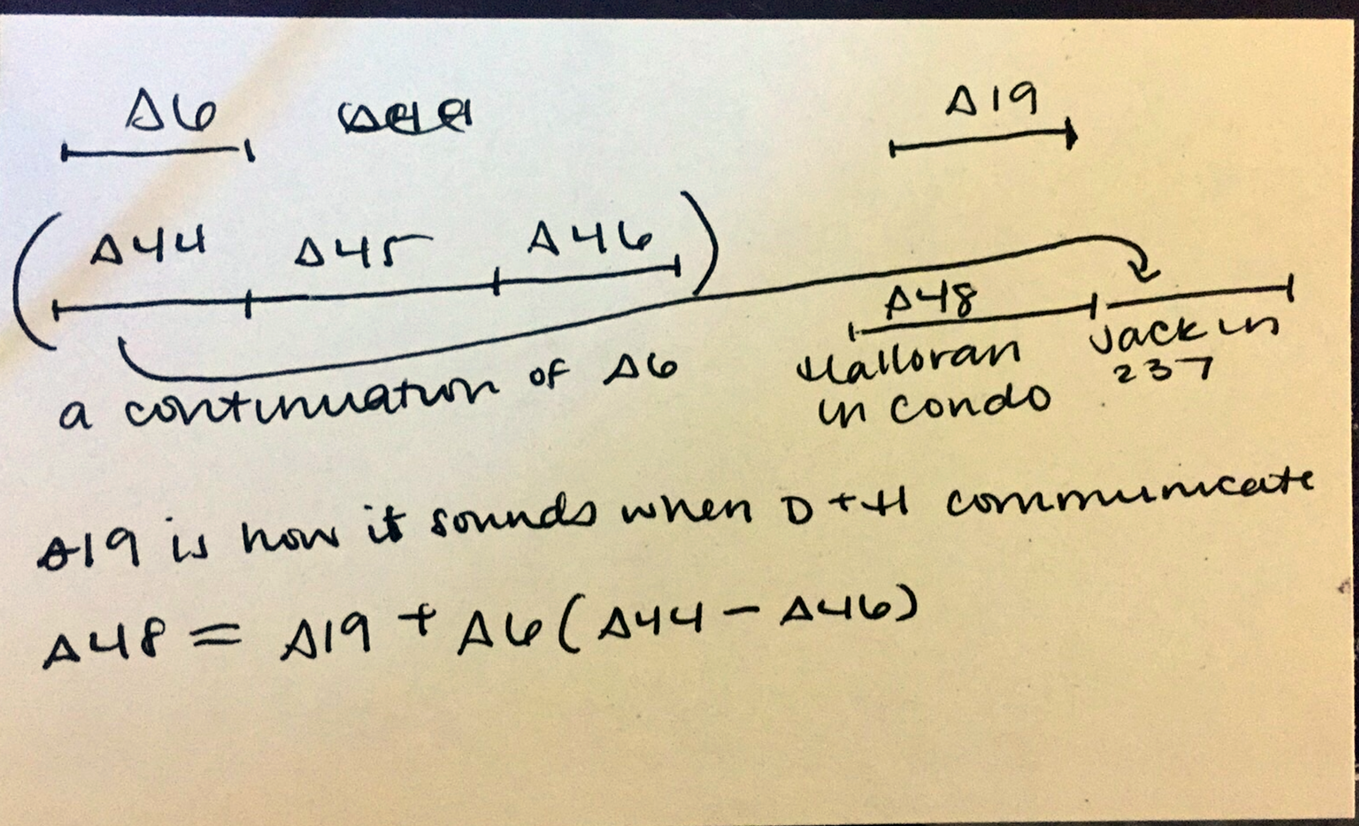
The sound repetition form interesting connections; almost like a short hand for themes and messaging to be communicated.
A44 repeats the sounds/music used in A6, as Danny is talking with Tony. This moment that’s about to happen is the reason why Tony didn’t want to go to the hotel.
It continues through to A46, ending just as A47 begins, where as its use in A6 ends in a crash as the Dr.’s voice is heard talking with Danny.
A44:I728 / THEMATIC REFLECTION, COMPOSITION REFLECTION
Danny playing with toys on 2nd floor carpet.
Shown A30 the 2nd floor, and Room 237, were around The Colorado Lounge- or where Jack considers his workspace.
See: Abuse Narrative, Danny and Jack’s work, The Incident
A44:I730 / THEMATIC REFLECTION, SCENE REFLECTION
Danny shown playing in the same spot as A30.
A30:i556
See: open and closed doors,
A44:I730 / THEMATIC REFLECTION, COLOR REFLECTION
Danny’s blue sweater visually becomes the trike.
See: Danny’s trike, blue
A44:I731 / THEMATIC REFLECTION, COMPOSITIONAL REFLECTION
The elevator and the stairs, the maze
See: the maze, parallel and perpendicular
A44:I731 / THEMATIC REFLECTION, COLOR REFLECTION
The elevator and the stairs, the maze
the color palette shown here is repeated A58:i1197
A44:I731 / THEMATIC REFLECTION
tennis ball related to Jack
the sequence of A23; Danny playing around Jack’s workspace and then A25 with Jack in the same space (Co Lounge) and playing with a tennis ball creates the semiotic link that the tennis ball is connected with Jack.
A44:I734 / THEMATIC REFLECTION, BROWN PLAID CHAIRS
See: Plaid, brown
same chairs as A87 Blood hallway
A6:i162
A87:i2044
A44:I737 / THEMATIC REFLECTION: HUNTING BLIND
The Maze, Abuse, American History
the trees in the background and the lamp shown in the mirror reflection
A design/compositional placement that’s shown in other aspects:
A53:i1065— Kubrick shooting behind large fake plants
A63:i1290-i1292— Kubrick creates Jack coming from the black and white photos (or at least the shadows)
A74:i1760—Kubrick shoots behind kitchen equipment
A77:i1785—Jack finds high ground
A78:i1792-i1793— Jack comes from the pillar to strike Halloran (A63 from a different angle)
A44:I739 / THEMATIC REFLECTION AS SOUND REFLECTION
The same music as A6:i129 “Why don’t you want to go to the hotel?” and the image sequences- which never show Room 237 or inside of it (as in A48).
As A44 plays out until A45, the scene expands (where as A6 cuts off when the Dr. begins to talk to Danny).
01 / Original vision · 2010
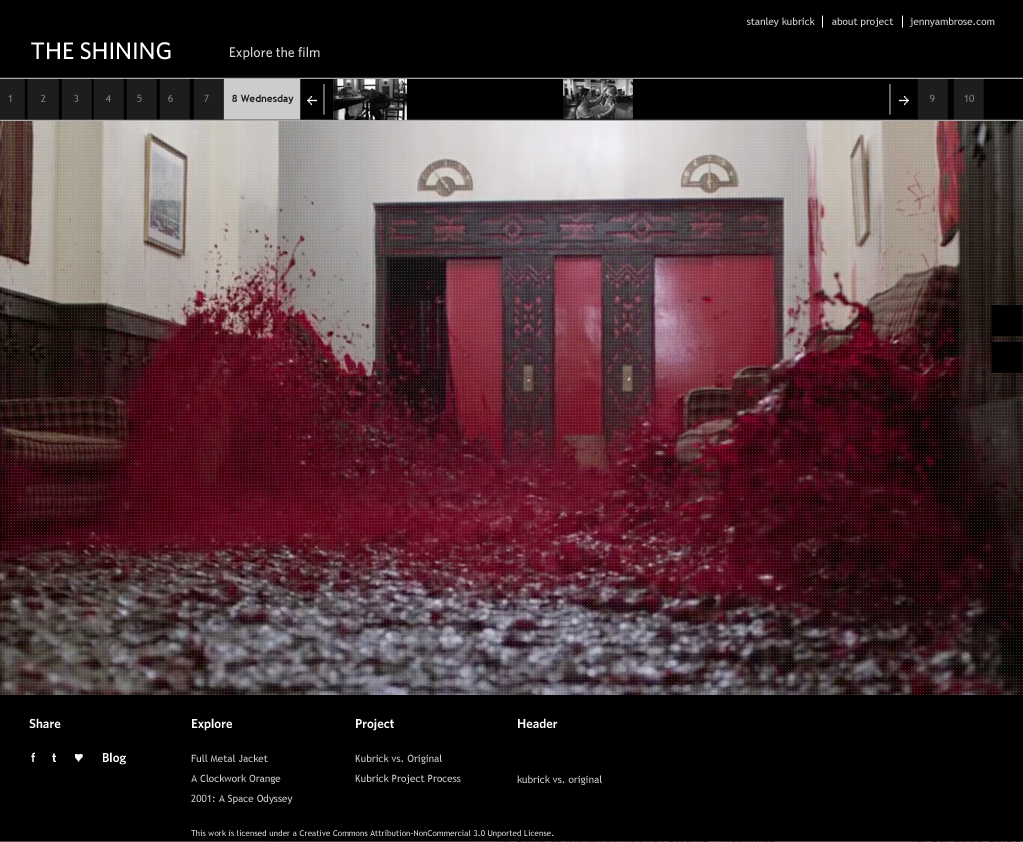
Initial product concept
The first design already placed the film at the center of a scene-based, exploratory experience, using numbered navigation, a filmstrip, and a restrained dark interface.
02 / Interface exploration
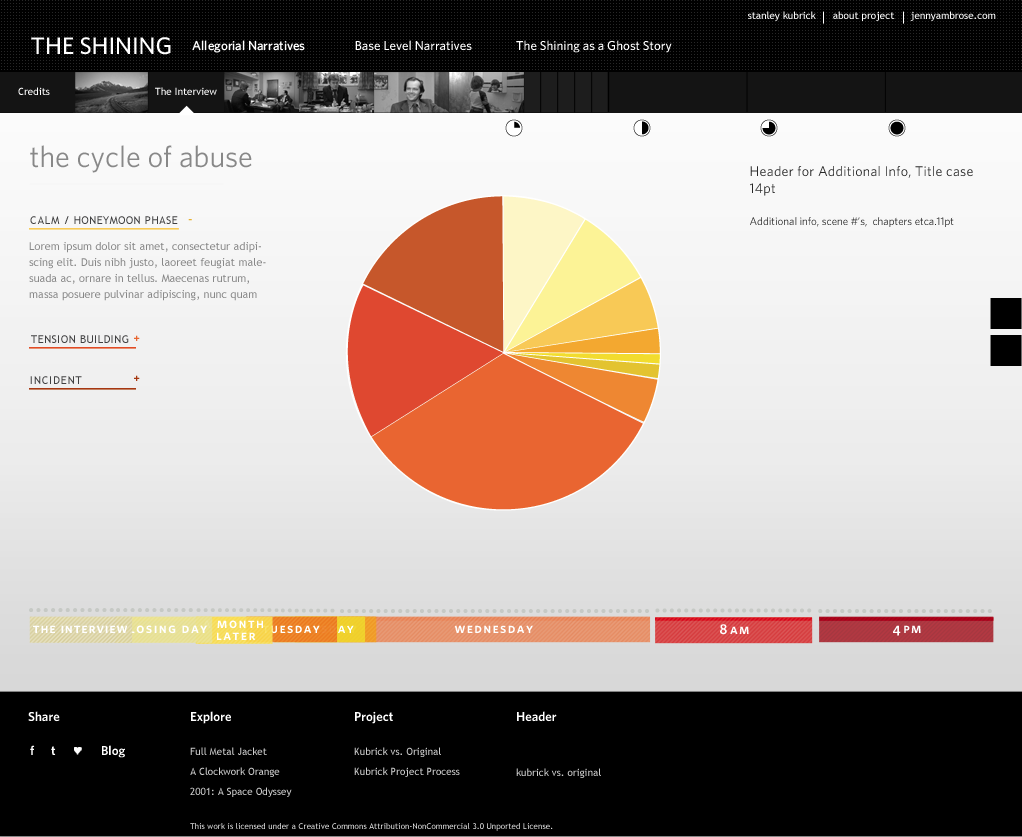
Developing the experience
An intermediate screen explored how the research, imagery, and navigation could coexist in an interactive environment.
03 / Reconsidering the direction
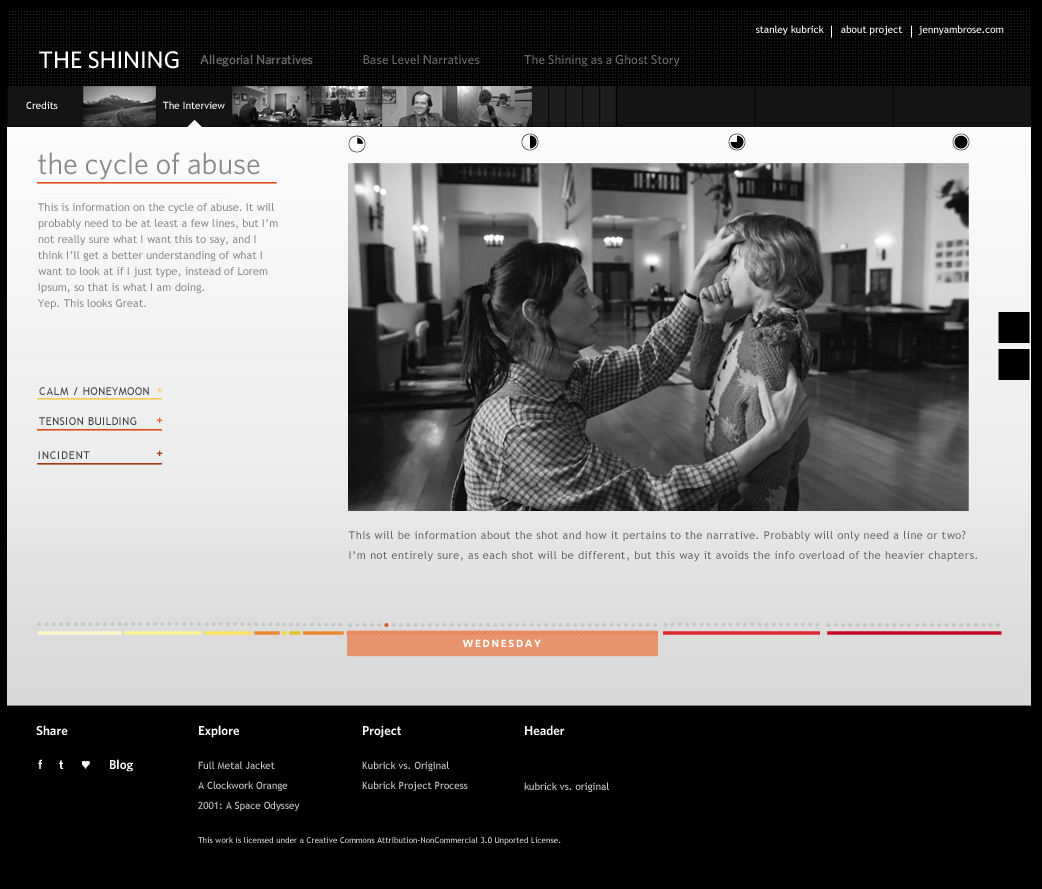
Returning to the information
This design direction exposed a larger problem: the information needed to be mapped in greater detail before the interface could meaningfully represent its relationships. The next phase moved from screen design to the written research documentation shown in section 03.